The setup is only a small part of the trade.
That sounds backwards because most traders spend almost all their time hunting setups...
They want the pattern, the signal, the indicator, the perfect entry, the clean chart, the magic candle.
I get it. I've done that. Every trader has.
But after more than two decades in markets, I've learned that finding a trade is rarely the hard part.
The hard part is surviving your own reaction to the trade after you're in it.
Because the market has a nasty way of turning a simple position into a full psychological audit.
- Fear floods in...
- Greed shows up...
- Ego steps in...
- Then hope takes over and pretends to be a strategy.
A chart is only a risk tool
Charts are useful...
But they are only a visual representation of the actions buyers and sellers took in the past.
Look, I've built a career around reading them, trading from them, and teaching people how to understand price action...
But a chart doesn't predict the future.
A chart gives you a map of possibilities. It shows you where buyers showed up, where sellers took control, where a breakout might matter, where a breakdown would invalidate the trade.
That's the real value.
It gives you a place to define risk...
And to map out the future possible paths price action could take.
Most newer traders want charts to give them certainty. That's where things get expensive.
A head and shoulders pattern doesn't pay your mortgage...
A wedge doesn't magically put money in the account...
A breakout is just a breakout until you know where you're wrong, how much you're risking, and what you'll do if the market proves you early, wrong, or just impatient.
The chart is the starting point. The trade is the whole plan of action around it.
Setups get too much attention
Most struggling traders have this backwards.
They think the next setup will fix the account.
So they keep looking. New scanner. New indicator. New Discord group. New guru.
New version of the same old promise: "This time I'll find the trade before everyone else."
But if the trader can't size correctly, cut losses, sit through noise, take profits, or stay emotionally neutral, the setup won't save them.
A good setup in the hands of a bad operator becomes account damage.
A trader has two jobs:
- Find and enter high probability opportunities with solid reward-to-risk ratios.
- Manage the position with no regrets, in the face of uncertainty, no matter the outcome.
That's why trade identification is often overvalued...
Because execution is where the money is made or lost.
- Sizing matters more than the entry.
- Exits matter more than the entry.
- Emotional control matters more than the entry.
- A repeatable process matters more than the entry.
The entry gets the attention because it's easy to screenshot. The boring stuff is what keeps you alive.
Hope is account poison
Hope is one of the most dangerous emotions in trading because it feels noble while it's destroying discipline.
A trader takes a position. It starts moving against him. The stop was obvious before entry, but now the chart feels different because money is on the line.
So he waits.
Then he adjusts the story...
Then he finds a new timeframe that makes the trade look better...
Then he looks for someone online who agrees with him...
Now a manageable loss has turned into a personal referendum...
This is how traders get stuck.
The loss was supposed to be a business expense. Instead, it became a threat to identity.
I've watched this happen in every market cycle since 2002...
Stocks, futures, Bitcoin, altcoins, all of it.
Same psychology, different tickers.
The market doesn't care how much research you did. It doesn't care how badly you want the trade to work. It doesn't care that your favorite analyst agrees with you.
The market only cares about orders.
Hope delays the order you should have placed when the trade was still small and clean.
Protect the operator
There are financial drawdowns and emotional drawdowns.
Financial drawdowns are obvious. The account is down. The number is right there.
Emotional drawdowns are more dangerous because they don't always show up on the statement.
You start hesitating on good trades...
You revenge trade bad ones...
You cut winners too early because you're desperate to feel smart again...
You hold losers because taking the loss feels like admitting you're the kind of person who gets it wrong.
The account can recover before the trader does.
This is why position sizing is so boring and so powerful. Good sizing protects more than capital. It protects judgment.
When the size is right, you can think.
When the size is wrong, the trade starts thinking for you.
Pros are boring on purpose
The best traders I've met are usually less dramatic than people expect.
They aren't screaming about every candle. They aren't building their identity around bold calls. They aren't trying to prove they're the smartest person on the internet.
The good ones are usually calm, process-driven, and almost painfully boring.
That's a compliment.
I've noticed successful traders are also people who are used to being in high-risk situations, like firefighters and pilots.
The least successful traders I've met are typically big-ego CEO types or attorneys that are used to bullying people around and forcing their will on the earth.
Markets punish the need to be seen... or the need to be right.
Screenshots, victory laps, public certainty, testosterone trading, all of that stuff feels good until the market changes character.
Then the trader has to defend a persona instead of managing risk.
That's poison.
A serious trader can be wrong without becoming unstable. He can take a loss without turning it into drama. He can wait without needing to manufacture action.
This is one reason I've always respected old-school market operators. The best ones don't treat trading like entertainment. They treat it like risk work.
I like to consider myself a retired trader who only comes out of retirement for the best opportunities.
Crypto makes the problem worse
Crypto is the perfect laboratory for bad trading psychology.
When price goes up, people call it destiny.
When price goes down, they call it manipulation.
Bitcoin can respect classical charting principles better than most people expect. I've traded it through every cycle since 2013, and price action is still truth...
But crypto also attracts narrative addiction.
People see patterns that aren't there because they want the position to work. They call every consolidation a launchpad. Every dip is the final shakeout. Every influencer has a chart proving why $250K is next.
Maybe price goes there eventually...
Maybe it doesn't.
That's the wrong question for a trader.
The better question is simple:
"What's the setup, where am I wrong, how much am I risking, and what do I do if the market gives me the opposite answer?"
Without that, you're just gambling.
The law of large numbers
One trade doesn't prove anything.
A pattern's value shows up over many repetitions. You need enough trades, enough discipline, and enough emotional stability to let the math reveal itself.
That's hard because humans want certainty now.
We want the one trade that validates the whole worldview...
But serious trading usually works the other way.
You take a lot of small losses. You scratch a lot of trades. You have periods where nothing feels clean. Then a few right-tail winners pay for the waiting.
That's why survival is the edge beneath the edge.
If you size too big, you don't get enough repetitions.
If you can't take losses, you don't get enough repetitions.
If you turn every trade into an identity test, you don't get enough repetitions.
The trader who survives gets to keep playing the game.
My rule
At this point in my career, I don't care how good a trade looks if the risk doesn't make sense.
I want to know what I'll do if I'm early, wrong, or right faster than expected.
That's the whole game.
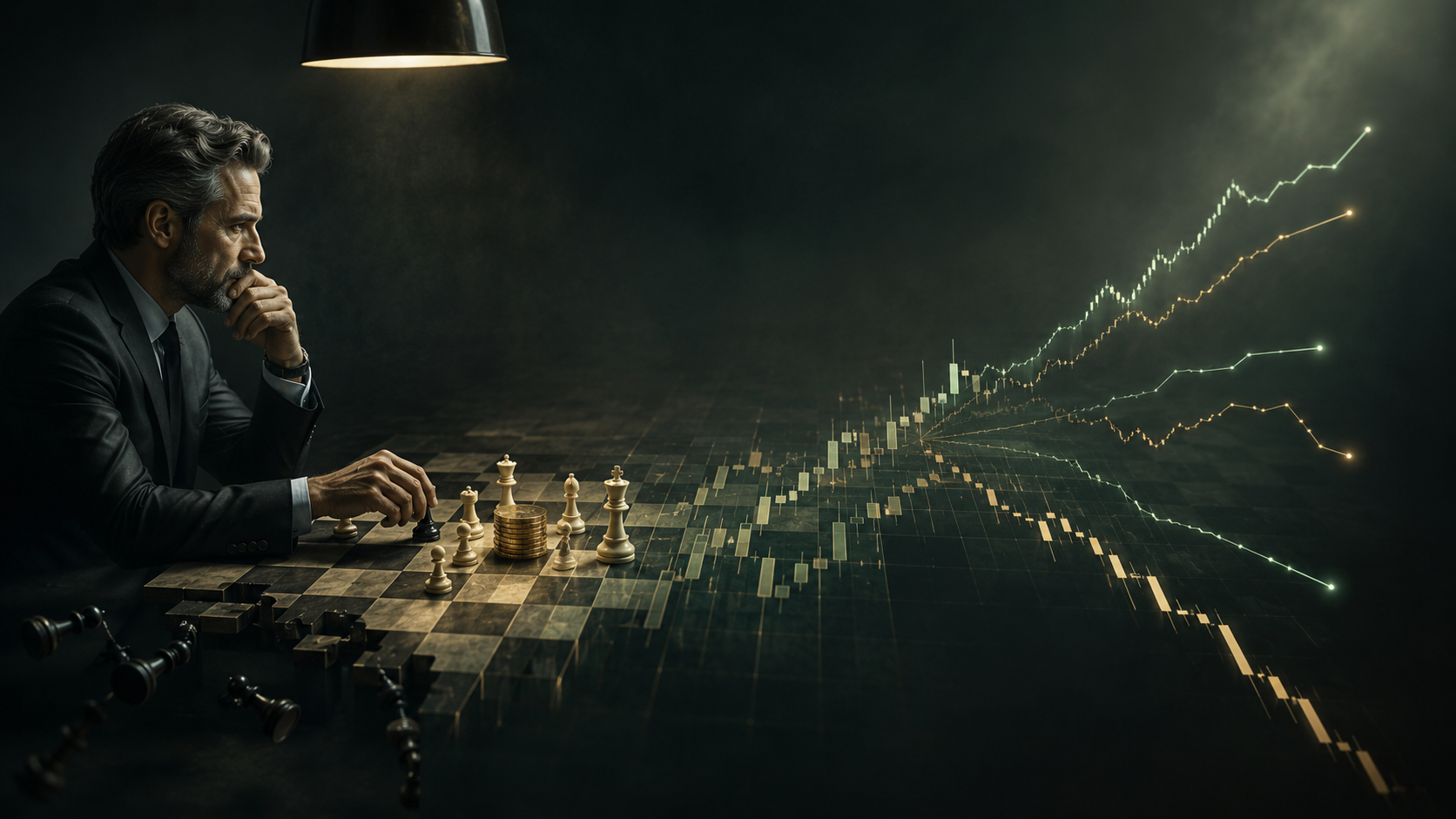
I like to think of trading like playing chess...
We have to think four to five moves ahead and know what we would do in most scenarios.
Trading works best as a process built to survive imperfect information. Perfect prediction is fantasy.
The trader who needs certainty is fragile.
The trader who manages risk can stay dangerous for a long time.
And in markets, longevity is underrated.
You only have to get rich once...
But you do have to stay in the game long enough for the right trade to work.